
Table of Contents
Short Answer
Indian students can reach Gulf airlines through cadet pathways, but mostly as self-funded candidates. The sponsored Emirates and Etihad programmes are for UAE nationals, and Qatar Airways’ sponsored scholarship is for Qataris. Indians can apply to Emirates Flight Training Academy and flydubai’s Ab Initio programme, or to Qatar’s resident intake if they live there. None of these guarantee a job.
Quick Facts
- Emirates and Etihad sponsored cadet programmes: UAE nationals only.
- Emirates Flight Training Academy (EFTA) international cadets: self-funded, 104 weeks, tuition listed at USD 181,650 including 5% VAT (medical insurance extra).
- flydubai Ab Initio: self-sponsored for non-UAE nationals, 18 to 24 months, AED 1,000 plus 5% VAT assessment fee.
- Qatar Airways: sponsored scholarship for Qataris. The recent self-funded MPL intake was for Qatar residents or those born in Qatar.
- Job guarantee: EFTA states it offers none with Emirates or flydubai. flydubai cadets join a pool first.
- Medical: Gulf programmes ask for a GCAA or QCAA Class 1 medical. Check your fitness early.
You’ve seen the posts. “Join Emirates as a cadet pilot. Fully sponsored. Apply now.”
Then you click, and the fine print says UAE nationals only.
That’s the problem with Gulf airline cadet programs for Indians. The headlines sound open to everyone. The rules usually aren’t. Some programmes are free but closed to you. Some are open to you but cost over a crore. And almost none promise a job at the end.
This guide sorts it out. You’ll see which programmes Indians can really apply to, what they cost, how long they take, and the smartest route to a Gulf cockpit if you’re starting from 12th standard or already hold a CPL.
What Are Gulf Airline Cadet Programs?

A cadet programme takes you from zero flying hours to a licence that an airline can use. You study ground school, fly single and multi-engine aircraft, then train on simulators for airline-style flying.
In the Gulf, three types exist:
- Sponsored national programmes. The airline pays. You sign a bond. Only citizens qualify.
- Self-funded international programmes. You pay. The academy or airline trains you. Jobs are not guaranteed.
- Employee programmes. Staff already working for the airline apply to retrain as pilots.
Most Indian applicants fall in the second group. Knowing that early saves you months of chasing programmes you can’t join.
Programmes mentioned most often
- Emirates: National Cadet Pilot Programme (UAE nationals) and Emirates Flight Training Academy international cadets (self-funded).
- Qatar Airways: Cadet Pilot Programme at Qatar Aeronautical College, leading to a Multi-Crew Pilot Licence (MPL).
- Etihad Airways: Cadet Pilot Programme in Abu Dhabi and Spain, for UAE nationals aged 18 to 29.
- flydubai: Ab Initio Pilot Training Programme, launched in 2025, built as an MPL pathway.
Who Can Actually Apply? Eligibility for Indian Candidates

Here’s what each airline publishes. Rules change, so confirm on the official page before you pay anything.
| Programme | Open to Indians? | Key requirements |
|---|---|---|
| Emirates National Cadet Pilot Programme | No | UAE nationals only; fully sponsored and bonded |
| EFTA International Cadets (Emirates) | Yes, self-funded | Age 17 to 26; Grade 12 with English, Maths, Physics; TOEFL 510+ or IELTS 5.5 in each element; at least 160 cm; medically fit; eligible for UAE student visa |
| Qatar Airways national scholarship | No | Qatari national or child of a Qatari mother |
| Qatar Airways resident intake | Only if you live in or were born in Qatar | Valid Qatar residence permit or born in Qatar; age 18 to 26; secondary school completed; candidate arranges training cost |
| Etihad Cadet Pilot Programme | No (national programme) | UAE nationals aged 18 to 29; IELTS 5.5 or TOEFL 510; National Service done or exempt |
| Etihad Employee Cadet Programme | Yes, if you work at Etihad | Internal staff of all nationalities (10 places in its first round) |
| flydubai Ab Initio | Yes, self-sponsored | Meets age, education and English criteria set by flydubai; GCAA Class 1 medical |
Eligibility checklist
Before you apply to any Gulf programme, make sure you have:
- 10+2 with Physics, Maths and English
- A valid Indian passport
- IELTS or TOEFL scores that meet the airline’s minimum
- A medical you can pass. Start with our guide on DGCA Class 1 vs Class 2 medical rejection reasons
- Funds or an education-loan plan in place
Not sure where you stand? Our Cadet Pilot Preparation team can check your profile against current criteria in one call.
How Does the Gulf Cadet Pathway Work?
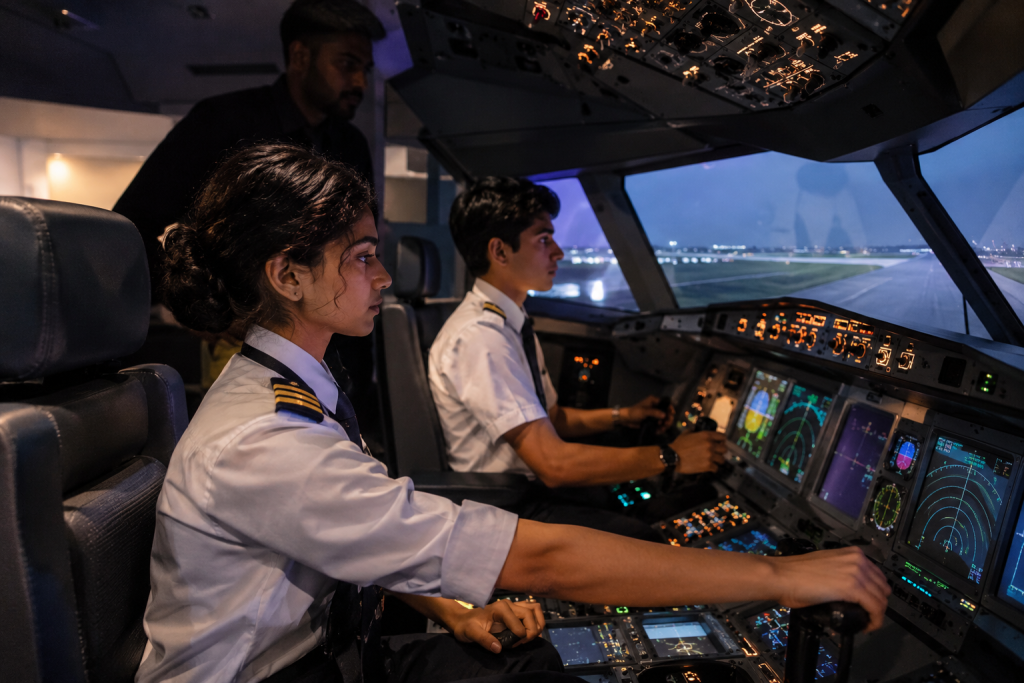
The steps look similar across airlines. The details differ.
Step 1: Check the programme is open to you
Read the official eligibility page first. Look for nationality, age and funding. If it says “UAE national” or “Qatari national”, it isn’t for you.
Step 2: Apply and clear the assessments
Expect an online application, then aptitude tests, group exercises and an interview. EFTA invites shortlisted candidates to assessments in Dubai and asks you to cover your own travel. The assessment fee is non-refundable.
Step 3: Pass the medical
Gulf programmes need a Class 1 medical from the local authority, such as GCAA in the UAE. Don’t wait for the offer letter. Book a check early.
Step 4: Train, start to finish
Typical phases include ground school, single-engine flying, multi-engine flying, a multi-crew course and jet orientation.
Step 5: Wait for airline selection
This is where expectations clash with reality. Finishing training does not mean you’re hired.
Emirates Flight Training Academy and flydubai: how training works
EFTA (Dubai). International cadets take the exact same training as UAE nationals. The course runs about 104 weeks and ends with a Commercial Pilot Licence with Multi Instrument Rating approved by the GCAA, plus MCC and ATPL course certificates. Emirates says graduates can apply to the airline afterwards, but EFTA states it gives no employment guarantee with Emirates or flydubai.
flydubai Ab Initio. The airline’s FAQ gives this timeline:
- Ground school: 9 to 10 months at the flydubai campus in the UAE
- Core flying: about 4 months in the USA, Greece or another approved school
- Synthetic phase (MCC and jet orientation): about 6 months in the UAE
- Base and line training: 3 to 4 months
After that, cadets enter the flydubai Cadet Pool. Second Officer employment typically follows within 3 to 6 months, based on operational needs. Salary starts only when employment starts. Early cohorts train with partner schools including Egnatia Aviation in Greece and Skyborne Airline Academy.
Qatar Airways. The Cadet Pilot Programme leads to an MPL, with a foundation year if needed and about 18 months of pilot training. Under the national scholarship, cadets agree to serve at least five years after appointment as First Officer.
Etihad. Its two-year national programme runs in Abu Dhabi and Spain.
What Does a Gulf Cadet Programme Really Cost?
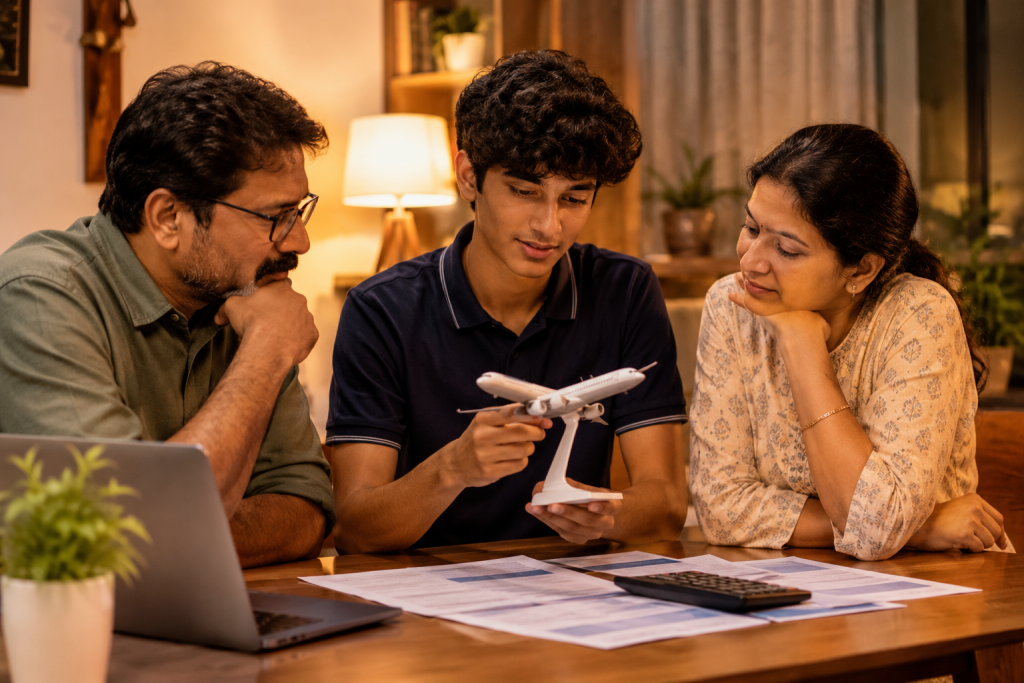
Be ready for a big number. EFTA lists tuition at USD 181,650 including 5% VAT, excluding medical insurance. At recent exchange rates, that’s well over ₹1.5 crore. Fees are charged in US dollars, so the rupee rate matters. The training fee covers the programme, materials, student visa and accommodation, according to EFTA’s FAQ. EFTA states it offers no scholarships or financing.
For flydubai, the published FAQ gives phase-based payments but not the full schedule. The one fixed number is the AED 1,000 plus 5% VAT assessment fee for invited candidates. Ask for the full fee table in writing before you commit. Accommodation in the UAE and meals aren’t included.
For Qatar’s resident intake, the airline says candidates arrange the training cost themselves.
| Programme | Who pays | Published cost | Job promise |
|---|---|---|---|
| Emirates / Etihad national programmes | Airline | Free for UAE nationals (bonded) | Employment route for nationals |
| EFTA international | You | USD 181,650 incl. VAT | None stated |
| flydubai Ab Initio | You | Phase-based; assessment AED 1,000 + VAT | Cadet pool; Second Officer typically in 3 to 6 months |
| Qatar Airways resident intake | You | Not published in the notice | Holding pool for slots |
Compare this with training in India or abroad through an Indian route. Our 2026 CPL cost comparison across India, Philippines, South Africa, Greece and the US shows the gap clearly. If the budget is tight, read pilot training for middle-class families in Kerala for funding options.
Key Insights
- “Sponsored” usually means “for nationals.” If an ad promises a free Emirates or Etihad seat to Indians, read the official page before you reply.
- Self-funded does not mean job-secured. EFTA says no job guarantee. flydubai has a cadet pool between training and employment.
- Residents have more doors open. Indian families living in Qatar or the UAE can see intakes that candidates in India can’t.
- The cost is dollar-based. A weaker rupee raises your real cost after you’ve started paying.
- There’s a second road. Many pilots get an Indian CPL, build hours and apply to Gulf carriers as direct-entry candidates.
What Are the Benefits of Gulf Cadet Programmes?
Even with the cost, people choose these routes for good reasons.
- A structured, airline-linked pathway
- Training is designed around airline standards, not just a licence.
- You learn multi-crew flying early.
- International exposure
- Training can include the UAE, the USA or Greece, depending on the programme.
- You work with mixed-nationality classmates, as you will on the line.
- Modern training tools
- EFTA uses classrooms with software built by Boeing for the academy and next-generation simulators.
- flydubai’s pathway includes jet-orientation and simulator phases.
- A path into Gulf aviation
- Graduation doesn’t promise a seat, but it puts you in front of the recruiters who matter.
Gulf Cadet Programme vs Indian Route: Which Is Better for You?
Both can work. The right pick depends on your budget, risk appetite and age.
| Factor | Gulf self-funded cadet | CPL in India or abroad, then direct entry |
|---|---|---|
| Upfront cost | High, often paid in USD or AED | Varies by school and country |
| Airline link | Strong, but no guarantee | You build it yourself |
| Licence | GCAA or QCAA based (MPL/CPL-IR) | DGCA CPL, convertible later |
| Hiring path | Airline pool or application | Hours + type rating + direct-entry application |
| Flexibility | Tied to one system | Can target Indian and Gulf carriers |
If you want to stay flexible, the Indian route is worth a close look. Start with Cadet Program vs Self-Funded CPL: Which Gets You Hired Faster?. Our Commercial Pilot License course and DGCA Ground School are the usual first steps, and flight training is arranged in India, the Philippines, South Africa, Greece and the US.
Already hold a CPL? Our Airline Preparation for CPL Holders course covers interviews and simulator checks, and Type Rating is the next licence step for most direct-entry applicants. Trained abroad? See the DGCA Licence Conversion course and this foreign CPL to DGCA conversion checklist.
Curious how the money looks once you fly? Read our breakdown of pilot salary in India.
How to Prepare for Gulf Cadet Assessments

Passing the application is only the first filter. Most Gulf selections add aptitude testing and interviews.
What the assessments test
- Aptitude: numerical, verbal, logical and spatial reasoning. Systems like ADAPT and COMPASS are common in airline selection.
- Group exercises: how you listen, lead and share the task.
- Personal interview: why you want to fly, how you handle pressure, what you know about the airline.
- English: IELTS or TOEFL, plus clear radio-style speaking.
A scenario we see often
A Kerala student scores well in Physics and Maths but freezes in the group exercise. He talks over others, thinks that shows leadership, and gets filtered out. Two mock sessions and some feedback change how he participates. Same student, same marks, different result. Assessments reward teamwork as much as brains.
Practise before the real assessment
Aerowis’ Cadet Pilot Preparation covers aptitude assessments, group discussion and mock HR interviews, with preparation for IndiGo, Air India, Akasa Air, Air Arabia and flydubai. Over 200 cadets have trained with Aerowis. Placement isn’t guaranteed, but preparation is.
Talk to a Career Advisor
Common Mistakes to Avoid
- Treating “Emirates cadet programme” as one thing Why it’s bad: The national programme and the international academy route are different. You may prepare for the wrong one. Fix: Read the nationality line first. Then check the academy’s own FAQ.
- Paying before you see employment terms in writing Why it’s bad: EFTA states no employment guarantee. flydubai has a pool stage. Your plan needs a Plan B. Fix: Ask for the policy in writing and read the contract before the first payment.
- Leaving the medical for last Why it’s bad: Failing a Class 1 after you’ve paid fees can end the plan. Fix: Get checked early. Our DGCA Class 1 vs Class 2 medical guide lists common rejection reasons.
- Ignoring currency risk Why it’s bad: Fees in USD or AED can rise in rupee terms mid-programme. Fix: Budget a buffer and confirm payment schedules with the school.
- Skipping aptitude and interview practice Why it’s bad: Strong students are filtered out for communication, not marks. Fix: Do mock rounds. Practise with feedback, not just videos.
- Believing coaching ads that promise a Gulf job Why it’s bad: No programme in this guide guarantees one. See Does a pilot course guarantee a job? Fix: Check any promise against the official airline or academy page.
Key Takeaways
- Emirates, Etihad and Qatar’s sponsored cadet seats are for their own nationals.
- Indians can join self-funded routes: EFTA and flydubai, plus Qatar’s resident intake if eligible.
- Budget for USD 181,650 at EFTA. flydubai fees need a written schedule.
- No programme here guarantees a job. Plan a Plan B.
- Book your Class 1 medical and English test early.
- Compare with the CPL + hours + direct-entry route before you commit.
Frequently Asked Questions
Can Indians apply to the Emirates cadet pilot programme?
The sponsored Emirates National Cadet Pilot Programme is for UAE nationals. Indians can apply to Emirates Flight Training Academy as international cadets, which is self-funded. Graduates can apply to Emirates later, but EFTA states it offers no employment guarantee. Always check the academy’s FAQ for current rules.
Does flydubai accept Indian cadets?
Yes. flydubai’s Ab Initio programme is open to international applicants and is self-sponsored for non-UAE nationals. Invited candidates pay an AED 1,000 plus VAT assessment fee. Training takes 18 to 24 months, then cadets join a pool. Second Officer employment typically follows within three to six months, based on operational needs.
Are Qatar Airways and Etihad cadet programmes open to Indians?
Not the main ones. Qatar’s sponsored scholarship is for Qataris, and Etihad’s cadet programme is for UAE nationals aged 18 to 29. Qatar has opened a self-funded MPL intake for Qatar residents or those born there. Etihad has also run an employee-only cadet programme for staff of all nationalities.
How much does a Gulf cadet pilot programme cost for Indian students?
EFTA lists tuition at USD 181,650 including 5% VAT, excluding medical insurance, which is well over ₹1.5 crore at recent exchange rates. flydubai uses phase-based payments with an AED 1,000 plus VAT assessment fee. Always request the full fee schedule in writing before paying.
What’s the best route for an Indian student who wants to fly for a Gulf airline?
There are two main routes. One is a self-funded cadet programme with an airline-linked academy. The other is an Indian CPL, then hours and a type rating, then direct-entry applications. The first is more structured but costly. The second is more flexible. Choose based on budget, age and risk.
Conclusion: Pick the Route That Matches Your Budget and Your Plan B
Gulf airlines are some of the most sought-after employers in aviation. But for Indians, the road isn’t the free cadet seat the ads suggest. It’s a self-funded programme, a resident-only intake, or a CPL-and-experience route.
None of that is a reason to give up. It’s a reason to choose carefully. Confirm eligibility on the official page. Get the fees and employment terms in writing. Book your medical. Practise for assessments. And compare the cadet route with building your career through a CPL and type rating.
Next steps: Check your profile, shortlist two programmes, and talk to an advisor who can compare both routes with your budget. You can also browse all our aviation training courses in India or learn more about Aerowis and meet the instructors. Based in Kerala? Visit the Calicut aviation training institute page, or see pilot course after 12th in Kerala.
Not Sure Which Gulf Cadet Route Fits You?
Talk to an Aerowis career advisor. We’ll check your eligibility, compare cadet and CPL routes against your budget, and show you how to prepare for aptitude tests and interviews.
Talk to a Career Advisor Call +91 85940 00730Aerowis Aviation, HiLITE Business Park, Palazhi, Kozhikode, Kerala · Mon to Sat, 9:30 am to 5:30 pm · info@aerowis.com